
Uncertainty and pressure characterize many young researchers
Only 1 in 4 young researchers would recommend a research career to other young people, a new report shows.
"This is a big problem for our society if young people lose faith in the research profession," says Steinar A. Sæther.
11.08.2026
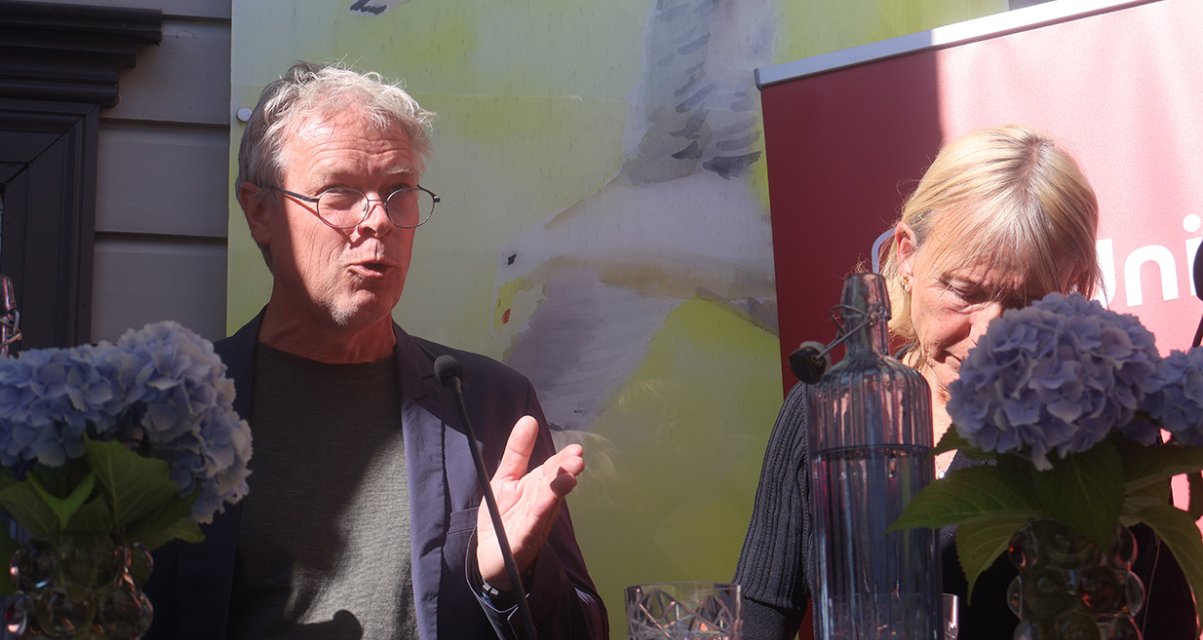
Forskerforbundet's president Steinar A. Sæther and a partially hidden UiB rector Margareth Hagen discussed career prospects for young researchers during Arendalsuka 2026
Together with the Young Academy of Norway, Forskerforbundet has conducted a survey of working conditions and career prospects among young researchers in Norway, which will be published shortly. The report builds on and further develops two previous studies, one from 2018 (in Norwegian) and one from 2022 (English summary).
And the trend is clear: The proportion who would recommend a research career to young people has fallen steadily, from 53% in 2018, via 29% in 2022, to 26.8% in 2026 among the comparable sample under 40 years of age.
The findings in the report were the subject of a panel discussion during Arendalsuka on August 11, where UiB Rector Margareth Hagen and State Secretary in the Ministry of Education and Research Eileen Fugelsnes (Labour Party) met AYF President Marte Emile Sandvik Haaland and Forskerforbundet's president Steinar A. Sæther for a debate.
– This is not about feeling sorry for young researchers. But it is a big problem for our society if young people lose faith in the research profession, says Sæther.
The findings in the survey give cause for concern:
- The proportion who would recommend a research career to young people has fallen dramatically: from 52.9% in 2018 to 29.4% in 2022 and 26.8% in 2026 (among respondents under 40 years of age).
- 56 percent are temporarily employed. Among temporarily employed, 65.7% perceive the possibility of a permanent job as relatively small – and only 21.4% envision working as a researcher in academia in Norway in ten years.
- Among temporary employees who are uncertain or do not wish to continue, 59.9% state uncertainty about future funding and job as their main reason.
- 77.7% report psychosocial health problems related to work to varying degrees. 40% report problems to some or a significant degree, the latter requiring accommodation or sick leave (14.1%).
- 61% of PhD candidates and postdocs lack a formal career plan. 67.7% have not received information and guidance on career paths, despite the fact that the 2024 regulations to the Universities and University Colleges Act require this.
Sæther believes the figures are "frightening, but not surprising".
– These figures confirm data from similar surveys, including a Nifu report from last year on the psychosocial work environment among researchers. The crucial thing now is whether we manage to address this properly. We must collectively take systematic steps for young researchers, so we see an improvement next time we conduct such a survey, he states.
Marte Emile Sandvik Haaland leads the Young Academy of Norway and is well aware of the challenges in young researchers' daily lives.
– It's about the future prospects, the desire it gives to spend many years of one's life on a research education. When the signals are that the sector faces tougher times, and the prospects for a permanent position are not so good, it does something to you. At the same time, the survey shows that there are also some low-hanging fruits to pick: For example, ensuring all candidates receive real career guidance, which many do not get today, she says.
The Rector of the University of Bergen, Margareth Hagen, believes more people should be concerned about the decline in the number of PhD candidates.
– The entire working life and business sector should be concerned about this, because there is a great need for research expertise in the future. We at the institutions can definitely do more for young researchers, and at UiB, we have, among other things, established an offer of psychological help and our own career center. But this is also about the working life and business sector increasingly valuing and utilizing the competence that PhD candidates have, she said.
State Secretary Fugelsnes agreed with this.
– The global growth markets of the future are very knowledge-intensive, and Norway will need much more research expertise if we are to keep up. The business sector must open its eyes to this. Norway currently only has two of the fifty largest R&D companies in the Nordic region, but this is about to change. Many PhD candidates will not work in academia, but in other parts of working life, and we must become much better at highlighting what research competence can be used for outside academia as well, she said.
She emphasized that a main focus for the government is to reduce the distance between academia and working life in general, and mentioned, among other things, requirements for co-financing from the business sector and the "Koblingsboks" scheme, which aims to connect businesses and research environments, as examples.
Steinar A. Sæther agreed that there is much to gain by increasing understanding of research competence in working life, but also added:
– This is also about hard realities: The number of recruitment positions has fallen significantly in recent years, and overall there are now 2000 fewer scientific positions at universities and university colleges. At the same time, clear political signals are being given that there will be tight times in the knowledge sector going forward. It is not surprising that this affects young researchers' views on future prospects, he believed.
The government has appointed an expert committee to review doctoral education, and the committee's leader Silje Haus-Reve was present during the debate. She emphasized that the findings in the survey would become part of the knowledge base for the committee's work.
A recording of the debate can be viewed here
See also the article about the report in the newspaper Khrono (in Norwegian)